Architecture¶
A layered tour of how codewizard-sherpa is built. Start with the one-paragraph framing below. Each layer links deeper — read as much or as little as you need.
Three depths of reading
- 5 minutes — read this page only.
- 30 minutes — read this page + the Production design §1–§3.
- A few hours — add the ADR index and one or two phase final-designs.
In one paragraph¶
codewizard-sherpa is a Temporal-durable workflow envelope wrapping a Layered Hybrid Orchestrator with structured-data-driven domain knowledge feeding it. A Temporal workflow owns end-to-end durability. Inside, a LangGraph Supervisor (Layer 1 — Hierarchical Planner) dispatches into one of several SHERPA-disciplined subgraphs (Layer 2 — State Machine). Every transition between nodes in a subgraph passes through a Trust-Aware guard (Layer 3 — Microvm sandbox + objective signals) that decides advance / retry / interrupt-for-human. The LLM appears only at the leaves, called via the Agents SDK for judgment calls. The orchestration, gating, and control flow are deterministic at every level.
The hero diagram¶
flowchart TB
    subgraph TEMP["⏱  TEMPORAL — Durable workflow envelope (hours to days)"]
      direction TB
      subgraph PLAN["🧭 HIERARCHICAL PLANNER (Layer 1) — LangGraph Supervisor: reads intent, dispatches"]
        direction TB
        subgraph SUB["🛤  SHERPA-STYLE SUBGRAPH (Layer 2) — Pydantic state ledger; nodes never call nodes"]
          direction TB
          subgraph GATE["🛡  TRUST-AWARE GATES (Layer 3) — conditional_edge between every node; microVM sandbox; interrupt() on low trust"]
            direction TB
            LLM["💬 Leaf LLM calls<br/>via Agents SDK"]
          end
        end
      end
    end

    DATA["📚 Structured data feeds — MCP-served<br/>Skills · conventions · policies · exceptions · ADRs · solved examples"]
    DATA -. injects context .-> PLAN
    DATA -. injects context .-> SUB
    DATA -. injects context .-> GATE
LangGraph is the runtime engine. SHERPA is the architectural discipline. Trust-Aware is the safety layer. Temporal wraps everything with the durable-execution properties needed for workflows that span hours of LLM work and days of human review.
The 7-stage pipeline¶
Every per-repo migration workflow flows through seven stages. Each stage is a Temporal Activity or child workflow:
flowchart LR
    D[0 Discovery] --> A[1 Assessment]
    A --> S[2 Deep Scan]
    S --> P[3 Planning]
    P --> E[4 Execution]
    E --> V[5 Validation]
    V --> H[6 Handoff]
    H --> L[7 Learning]
L -. feeds back .-> P| Stage | What happens | LLM involved? |
|---|---|---|
| 0 Discovery | Scheduled scan of the org's repos; lists candidates | No |
| 1 Assessment | Classify the repo as Cat 1 / 2 / 3 with cited evidence | Sometimes |
| 2 Deep Scan | Probe Coordinator dispatches Layers A–G; emits RepoContext |
No (ADR-0005) |
| 3 Planning | Recipe-first → RAG → LLM-fallback (ADR-0011) | Sometimes |
| 4 Execution | Apply steps inside a microVM; commit atomically per step | Sometimes |
| 5 Validation | Build, test, SAST, CVE delta, Prove-It assertions | LLM judge only on disagreement |
| 6 Handoff | Open the PR with full evidence; wait for human review | No |
| 7 Learning | Record solved examples into the Knowledge Graph | No |
The shape itself is load-bearing — see ADR-0010.
What's running locally today (the POC)¶
The repository implements the gather layer (Stage 2 above) end to end, and is now building the first transform slice — deterministic vulnerability remediation (Stages 3–4), in progress. The codegenie CLI scans any directory into a structured RepoContext; the fix path then reads that context plus a local database of public vulnerability feeds, picks a deterministic fix recipe, applies it, and verifies the patched code in a locked-down sandbox. No Temporal, no Planner, no LangGraph — and no LLM anywhere.
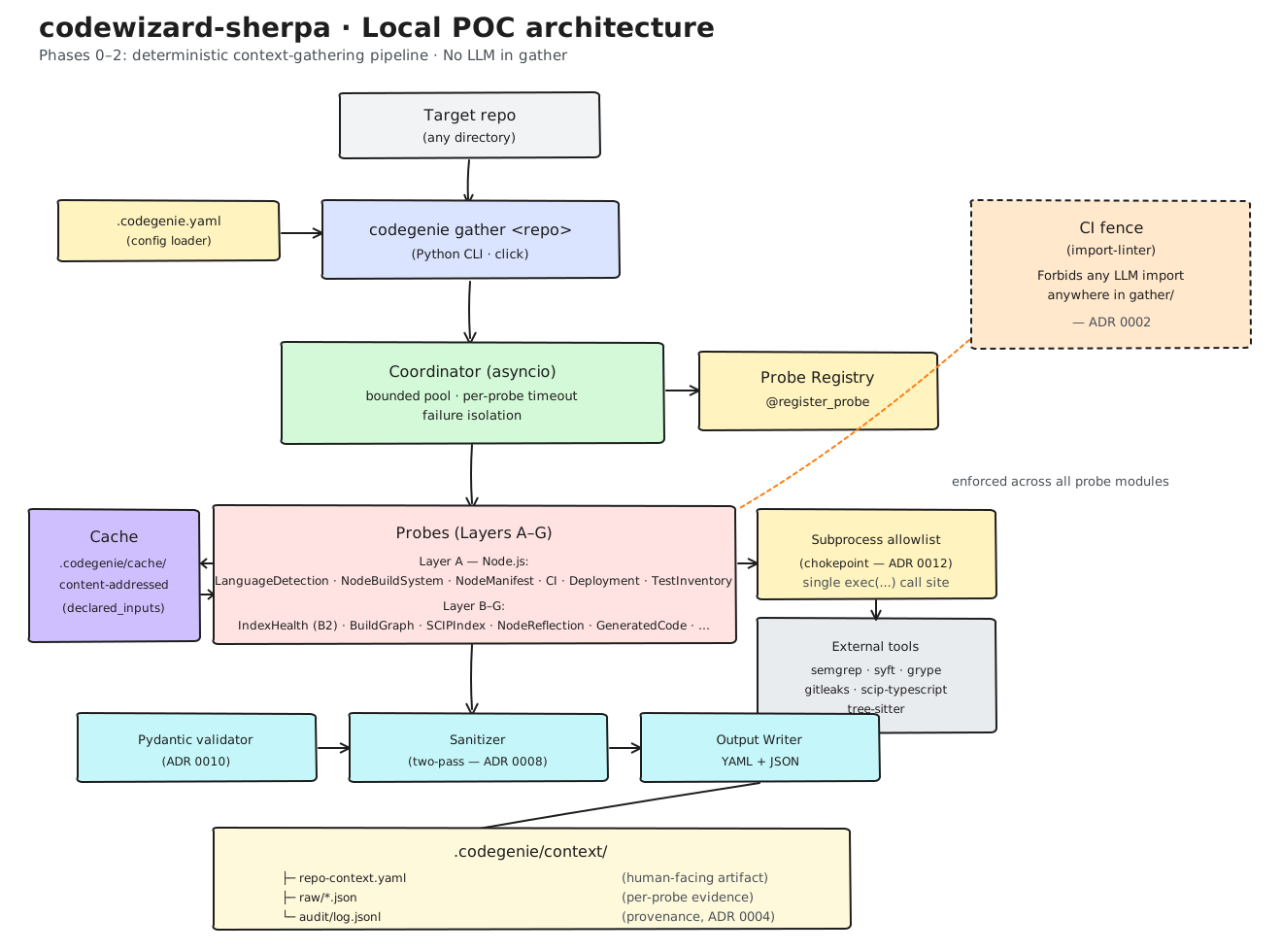
The probe contract that ships in the POC is identical to the one the production service will use (ADR-0007) — drift here would propagate everywhere. Bugs at this layer are foundational.
Load-bearing architectural commitments¶
Nine constraints that every subsystem must honor. Proposed changes that violate one require explicit justification and an update to docs/production/design.md §2.
- No LLM in the gather pipeline. Anywhere. Probes are deterministic; same inputs always produce same outputs.
- Facts, not judgments. Gatherer captures evidence ("trace observed 0 shell invocations"); never writes conclusions ("safe to migrate"). Conclusions are the Planner's job.
- Honest confidence. Every probe and every state node reports confidence + provenance. Silent staleness is the worst failure mode.
- Determinism over probabilism for structural changes. AI agents are "safer builders, risky maintainers" — use recipes for refactors; reserve LLMs for judgment calls.
- Extension by addition — no silent edits. New language / task / tool = new probes + new Skills + new subgraphs. Compiler- or fence-policed edits (a new
Literalmember, a struct field, an import line) are the enforcement mechanism, not violations; cross-cutting change uses the sanctioned migration path (ADR-0043). - Organizational uniqueness as data, not prompts. Skills, conventions, policies, exceptions all live as structured data the agent queries.
- Progressive disclosure.
RepoContextindexes evidence; doesn't inline it. Agents read originals at decision time via MCP. - Humans always merge. Autonomy ends at PR creation.
- Cost is observable end-to-end and bounded per workflow. Every LLM call, sandbox run, probe execution, reviewer-hour is measured and attributed.
These are summaries; the full text with rationale and per-commitment ADRs lives in docs/production/design.md §2.
Drill down¶
| If you want to understand… | Read this |
|---|---|
| The full production architecture, every layer, every persona | Production design (long; the canonical reference) |
| The why behind every architectural decision | ADR index (36 numbered records) |
| How the design will land, phase by phase | Roadmap (17 phases) |
| The deep design of a specific phase | The phase's final-design.md (linked from the Roadmap) |
| The 4+1 architectural views of a phase | The phase's phase-arch-design.md |
| The CLI surface and how to run it today | Get started |
Architectural views (4+1)¶
The production design carries the full Kruchten 4+1 set: Logical, Process, Development, Physical, Scenarios (+1) views. Each is a Mermaid diagram with prose around it. See Production design §8 for:
- §8.1 Logical view — components and their relationships
- §8.2 Process view — runtime behavior and concurrency
- §8.3 Development view — code organization
- §8.4 Physical view — deployment topology
- §8.5 Scenarios — vulnerability and migration walkthroughs
- §8.6 Persona view — who fires when (swimlane)
- §8.7 Component view — boundaries and what's swappable
- §8.8 Worker subgraph state machine — Migration Subgraph example
- §8.9 Trust-Aware gate decision flow — how every transition resolves
- §8.10 Cost view — where money is spent and where ROI is measured
Plugins: granular units of work¶
A plugin is a unit of (task × language × build-tool) work — e.g. vulnerability-remediation--node--npm. Each plugin bundles its own subgraph, TCCM, probes, Skills, recipes, and language search adapters. Adding a new language or task class is one new plugin directory, never an edit to existing code. The extension-by-addition test for the whole architecture lives in plugins.
See ADR-0031 for the full plugin model and Production design §4.8 for the wiring.
What's next on the architecture roadmap¶
The most recent architectural additions (May 2026):
- Phase 7.5 — Multi-language foundations + Python — the
LanguagePacktotal-value language contract; the second target language added by addition. See roadmap §Phase 7.5. - ADR-0043 — Extension by addition means "no silent edits" — a category-based fence replaces per-phase byte-edit allowlists; a sanctioned migration path covers legitimate horizontal change. See ADR-0043.
- Phase 13.5 — Operator portal (read-only views + plugin/task kill-switches). See ADR-0035 and ADR-0036.
- Phase 02 IndexHealthProbe (B2) — the single most important probe in the gather layer; catches silent index staleness (Phase 02 ADR-0006).
- ADR-0033 Domain modeling discipline — newtype + smart constructor + sum type + illegal-states-unrepresentable applied across new code from May 2026 forward.
- ADR-0034 Event sourcing as canonical primitive — one typed event log, every concern is a projection.